
How did HARPS begin?
In 2012 Horticulture Australia Ltd (now Hort Innovation) initiated a project to harmonise food safety certification requirements for the major retailers in Australia. The result of this project is the Harmonised Australian Retailer Produce Scheme (HARPS).
HARPS was an industry initiative. Industry approached Hort Innovation to ask for help in meeting multiple food safety schemes involved in supplying major retailers. Retailers agreed and were prepared to align their food safety requirements.
The initial HARPS project was funded by Horticulture Innovation Australia Ltd using across-industry levies and funds from the Australian Government. The scheme is voluntary and application for certification is open to all fresh produce businesses that supply the major grocery retailers. The project has been supported by the Australian Competition and Consumer Commission and the Australian Food and Grocery Council.
Over time, HARPS transitioned from being a project funded by Hort Innovation to a standalone entity, generating its own finances, in May 2020.
Who owns HARPS?
HARPS is a program that Hort Innovation owns and includes:
- The HARPS Database
- HARPS branding including the HARPS Logo
- HARPS Website content
- The HARPS Standard, Scheme Rules and all associated technical documentation
- HARPS training materials
Who manages HARPS?
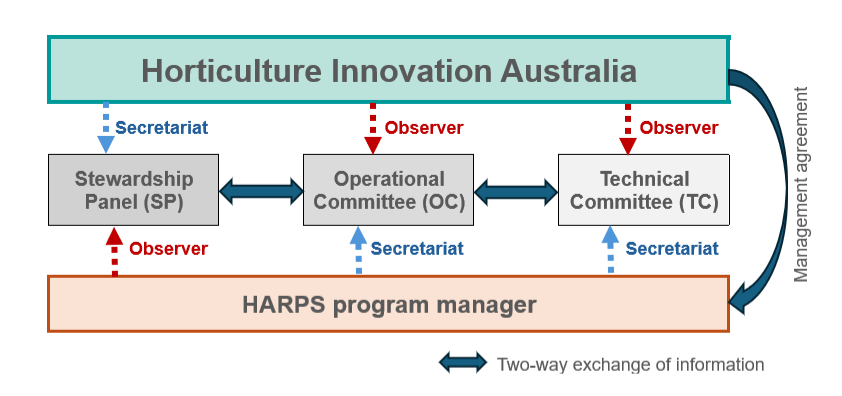
One Direction ANZ is the entity responsible for the ongoing management of HARPS. Following a competitive tender process run by Hort Innovation, a Management Agreement (Licence) was awarded to One Direction ANZ in May 2020 to manage HARPS. The Management Agreement details performance requirements to be met by One Direction ANZ on a six-monthly basis.
HARPS Governance Structure
HARPS is owned by Hort Innovation and operates under a governance structure comprising a Stewardship Panel, Operational Committee and Technical Committee. This structure provides governance and oversight of the HARPS program and supports the ongoing development and improvement of the HARPS Standard and associated technical documents.
Stewardship Panel
The Stewardship Panel has been established to provide objective governance and oversight of the HARPS program to Hort Innovation.
The responsibilities of the Stewardship Panel include:
- Consider recommendations and advice from the Operational Committee regarding the Standard (including associated technical documents) and provide consensus approval or seek further feedback.
- Monitor the cohesiveness of both the Technical Committee and Operational Committee and ensure intended objectives of each committee are being met.
- Define and guide the overall vision, mission or long-term strategic goals for the Standard.
- Oversee the HARPS Manager operational framework, strategic goals of the Standard and documents including the Management Agreement and milestones.
- Oversee the Cost Structures Principles and financial oversight.
- Approve the Communication Strategy and annual implementation plan.
The Stewardship Panel comprises an Independent Chairperson, three retailer representatives and three production industry/supply chain representatives.
Operational Committee
The Operational Committee is an advisory body established to provide objective governance and oversight of the HARPS program to Hort Innovation.
The responsibilities of the Operational Committee include:
- Provide input to the Technical Committee that supports the ongoing development and improvement of the Standard, including raising issues of concern relating to food safety, legal and trade compliance matters for the horticultural industry.
- Provide a consensus recommendation to the Stewardship Panel regarding the ongoing development of the Standard, referencing direction from the Technical Committee and the non-technical HARPS Manager.
- Provide key updates to the Stewardship Panel on critical communications with stakeholders, delivery, and implementation of the Standard.
- Receive quarterly trend reports from the HARPS Manager and provide advice to the Stewardship Panel on matters arising from the trend analysis.
- Provide trend reports and key data to the Technical Committee.
- Be the main point of contact for the Standard’s operational matters.
The Operational Committee comprises an Independent Chairperson, up to six retailer representatives and three production industry/supply chain representatives.
Technical Committee
The Technical Committee is an advisory body that supports the ongoing development of the HARPS Standard and associated technical documents.
The responsibilities of the Technical Committee include:
- Review, challenge and support the ongoing development of the Standard and associated technical documents.
- Collate, review and where necessary, validate technical data and information that underpins changes to the elements of the Standard.
- Identify and engage with relevant industry networks, peak industry bodies, and businesses during the review process.
- Make recommendations to the Operational Committee on the Standard.
- Provide advice and guidance to assist in informing the further development of the Standard to ensure it remains fit for purpose, including food safety, legal and trade compliance matters for the horticultural industry.
- Provide advice to the Stewardship Panel and its secretariat regarding the ongoing development of the Standard, including communication with stakeholders, delivery, business risk, and implementation of the Standard.
- Receive trend reports and key data from the Operational Committee.
- Be the main point of contact for the Standard’s technical matters.
The Technical Committee comprises an Independent Chairperson, four grower/peak industry body representatives, one supply chain representative, two retailer representatives, one GFSI program owner representative, one Certification Body representative and an independent technical specialist.